Making bagels while our house is on fire
LOUISVILLE — As many folks in my life know, I love a routine. On Tuesdays at 6 a.m., I punch in the door code at the bakery I work at. On Tuesdays, with music blaring far too loud, I hunker down with bagel dough forming between my hands as I knead out my fear and anger from the horrors occurring in our world.
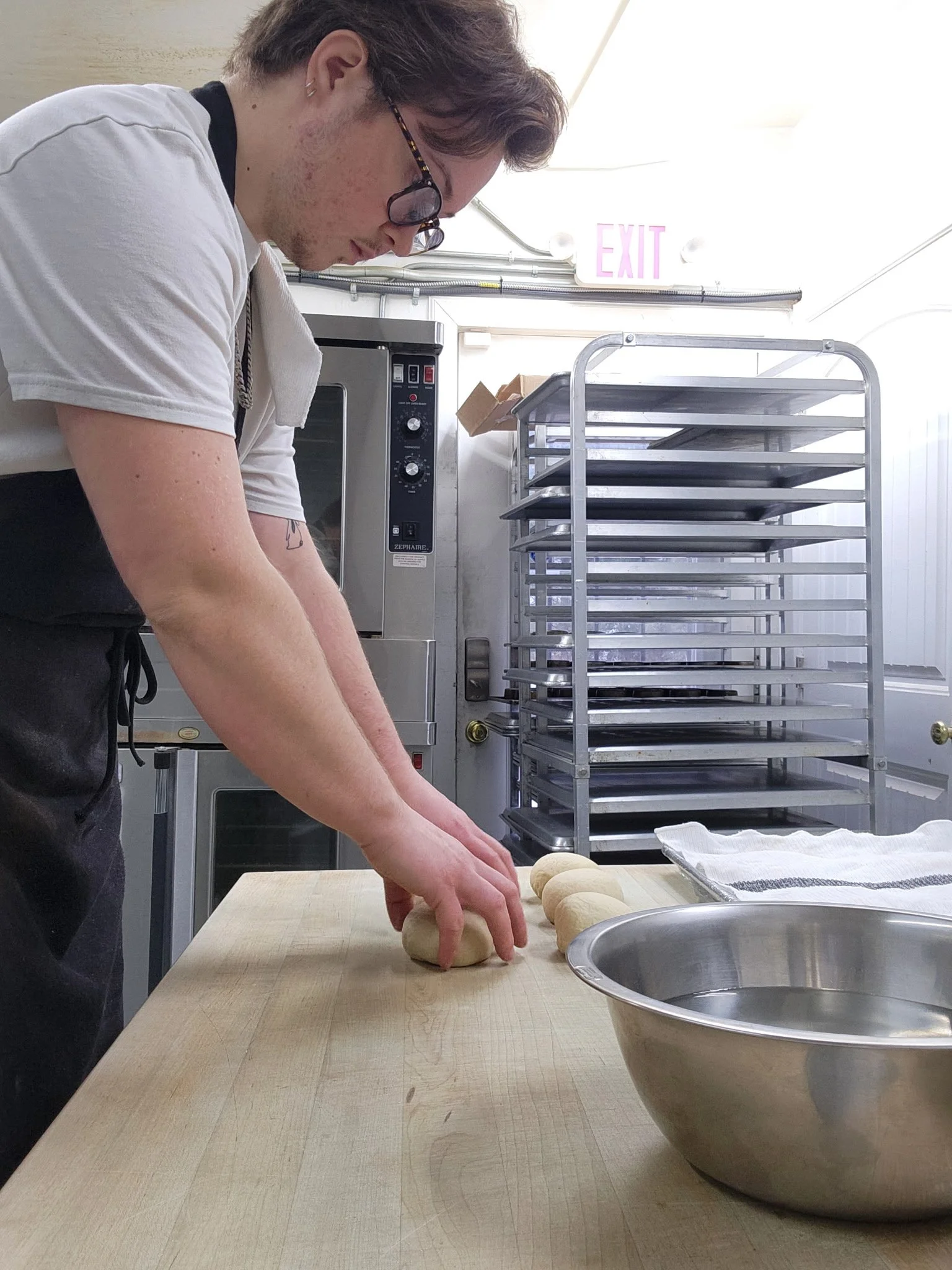
Daily, I bear witness to the wreckage of this administration in my social media and news feeds, in the tears of my favorite regulars at my job as a barista, in panicked texts from friends and loved ones… But on Tuesdays, I use that anger to create something amidst all the destruction around me.
On Tuesdays, my coworkers and I filter through our usual conversations about proofing times for dough, when the delivery truck would arrive, what the orders for our daily coffee run would be. In the past, Tuesdays have been days of solace. Last Tuesday, however, I could feel the heaviness as soon as I swung open the door – much of which swept in behind me, I’m sure. The past few Tuesdays have been heavy like this, too.
While we would all much rather be kneading dough, scooping batter and chatting about upcoming concerts and the adorable things our pets did over the weekend, everyone in the building was instead thinking about the atrocities that surfaced since the last time we saw each other.
A 5-year-old boy separated from his family to be used as bait. A disabled son dead after his father, his sole caretaker, was detained. Nine innocent lives taken in less than a month. The suffering inflicted by ICE underlines our lives like the “breaking news” at the bottom of a news channel: silently looping, perpetually updating, quietly seeping into every moment.
How can we think of much else? How can any of us keep going through the motions of our lives as if nothing is happening… as if we aren’t living in a modern Nazi Germany?
“I hunker down with bagel dough forming between my hands as I knead out my fear and anger from the horrors occurring in our world.”
My new routine consists of spending several hours every day asking myself what more I can do for my community in this time of immense hurt, and every day I come up empty-handed.
I share community resources with everyone I know. I donate food to the shelters nearby. I compile lists of warming centers and white flag shelters with my spouse so all my coworkers know where to direct community members in need during the harsh weather we’re experiencing in Kentucky right now. My home is open to everyone that needs a space to feel safe and loved and welcomed and cared for. Kameron and I host monthly events to bring our circle of folks closer together. I work with local nonprofits to support my community members in the ways I know how. Nothing feels like enough.
I understand that my actions provide temporary emotional or physical relief, which brings me hope and warmth and comfort... But at the end of the day, the issues I want so desperately to tackle are systemic – and making any impact on that level feels impossible. I know I am far from the only one feeling this way; everyone in my corner shares the same heavy sentiment.
So. What do we do?
Fortunately, I have some brilliant, strong, and wonderful people around me that give me real answers when I ask this question. After hearing so many thoughts and perspectives over the past few weeks, I’ve come to realize this:
We are all in a burning house.
I think we all are aware of this to some extent, and many of us have been for some time. Dr. Martin Luther King, Jr. used the same comparison over six decades ago.
In the face of a fascist, abusive administration that has escalated the problems that have long bubbled under America’s surface, I have come to understand this house analogy a bit differently when trying to view it as a house worth saving. This shift in perspective is courtesy of many conversations about intersectionality, and the feeling of impossibility when it comes to trying to be an activist about everything you believe in all at once. It comes with a new understanding of community, of who “we” refers to in that sentence.
(Get your shovels ready, folks. Nothing makes me happier than wearing an analogy into the ground.)
Let’s say that every room in this house represents a different core issue or movement that exists right now. One room is the Black Lives Matter movement, one is environmentalism, one is intersectional feminism, one is the anti-apartheid movement that harbors several different causes across the world, including justice for Palestine, Sudan, the DRC, and countless other countries suffering from oppressive, imperialist rule… and so on. You get the point.
We are only human, thus we can only stand in one room at a time. Putting out fires in this house takes a village; while I can only put in the work in one room right now, I am relying on someone somewhere else to stand strong in another, chipping away at the work that needs to be done there.
We can share our tools – methods of collective action, knowledge of organizing and mobilizing people, ways of educating and debating and advocating, and the like – with each other as we shuffle between rooms, building and expanding our networks of collaboration and mutual aid. I can feed the folks working in every room with encouragement, warm meals, and a place to gather. I can remind everyone that will listen that the work in one room helps further the efforts of the whole house. But I can still only work in one room.
As a village, it’s time to focus our efforts. For one reason or another, we can’t all be marching in the streets. But we can all do something. We can cook for our neighbors in need, host gatherings in which we share our fears and hopes and ideas, talk to those around us about the things in our community that are in need of protecting or changing. We can create in a time of destruction, rest in a time of overwhelm, ease the burden of others in a time of overworking. We can donate our time or money. It’s hard to do all of these things for all of the causes we believe in. Truthfully, for the average person, it’s not just hard. It is impossible. But if each of us show up in one of these ways, it means that we free up the space and time and energy for our friend or neighbor to show up in their own way.
What I suppose I am truly proposing is for all of us to shed the societal conditioning that tells us independence is paramount. I am asking us to lean into the idea of dependence, of reliance, of care and trust in our neighbors, friends, and fellow community members.
In a world that tells us to watch our backs, the most radical thing we can do is look forward. I implore you to watch someone else’s back instead, and trust that someone else is doing the same for you.
And to all the folks I know personally who’ve taken the time to read this, please know that it is okay to breathe for a moment – Kam and I are looking out for you.
With all the love and rage and fear and hope in my heart, I bid you all adieu for now.
See you in the streets!
Haiden Hall